

Trade school costs vary widely, from around $1,000 for a short, single-skill certificate to $30,000 or more for a longer diploma or associate degree program. Most complete programs, the kind that prepare someone for an entry-level job in a trade, run somewhere between $10,000 and $25,000 in total tuition. Total cost depends heavily on which school, program, and credential level a student chooses.
There is no single government report that lists trade school tuition by specific trade nationwide. The numbers below combine industry pricing data with the federal cost and financial aid data.
Average Cost by Trade
These figures come from industry pricing guides and program benchmarks, not one official government source. No federal agency, including the National Center for Education Statistics (NCES) or the Bureau of Labor Statistics (BLS), tracks tuition by individual trade nationwide, so treat these as realistic ranges rather than official averages.
A note on the low end of these ranges: the cheapest programs in any trade are usually short, single-skill certificates, not a full diploma or associate degree. A shorter certificate can be the right fit for some careers, but it typically covers less material and may not include the accreditation, job placement support, or full hands-on training that a longer program provides. Confirming what a program includes, and whether it’s accredited, matters more than comparing the lowest sticker price alone.
| Trade | Typical Cost by Credential | Notes |
| Electrical | Certificate: $4,400-$9,229 Diploma/private program: $15,000-$25,000 |
Public community colleges run the low end. Private career schools, including longer diploma-length formats with more shop hours, commonly run $15,000-$25,000. |
| HVAC/R | Certificate (6-12 mo.): $1,200-$20,000 Diploma/Associate (18-24 mo.): $15,000-$35,000 |
Community colleges sit at the low end of the certificate range. Private schools and longer diploma or associate-level programs run $15,000-$35,000. |
| Welding | Certificate: $2,800-$10,000 Diploma/private program: $5,000-$22,700 Associate degree: $10,000-$30,000 |
Community college and technical school programs average $5,000-$15,000. Private diploma programs can run $18,700-$22,700 in tuition, or up to $29,150 with fees included. |
| Diesel/Automotive | Certificate: $1,000-$8,000 Diploma: $1,000-$16,500 Associate degree: $10,000-$40,000 |
Community college certificates and diplomas typically run $1,000-$16,500. Private institutes offering a longer, tools-included program can run as high as $36,500. |
| Plumbing | Certificate: $1,000-$3,000 Associate degree: $9,000-$30,000 |
Cost depends heavily on state licensing requirements and program length. Full associate degree programs cost significantly more than a short certificate. |
| Medical Assisting | Certificate: $1,500-$15,000 Diploma: $3,400-$27,100 Associate degree: $8,000-$40,000 |
Certificate programs are the most common path into the field. Diploma and associate degree programs cost more but include deeper clinical training. |
| CDL/Truck Driving | Community college/subsidized: $2,000-$4,500 Private CDL school: $3,000-$10,000 |
Prices run highest in states like California and the Northeast. Some carriers also offer free company-sponsored training in exchange for a driving commitment after graduation. |
| CNC Machining | Certificate: $2,000-$5,000 Diploma/private program: $5,000-$19,000 Associate degree: $10,000-$20,000 |
Some community colleges offer no-cost CNC training through partnerships like America’s Cutting Edge, though seats are limited. |
As a rough rule of thumb across trades, short certificate programs (3-12 months) usually run $1,000-$15,000. Diploma programs (9-18 months) usually run $3,000-$27,000. Associate degree programs (18-24 months) usually run $8,000-$40,000. These are general patterns, not exact government figures, and the specific trade matters as much as the credential type.
For comparison, average tuition and fees in 2022-23 ran about $4,000 a year at public two-year colleges, $9,800 a year at public four-year colleges, and $40,700 a year at private nonprofit four-year colleges, according to NCES. Full cost of attendance at a four-year school, including tuition, fees, books, and housing, runs $27,100 to $58,600 a year depending on the type of school. Trade programs usually run well under two years total, so the full cost is a fraction of that, even before counting the lower per-year price.
What Affects Trade School Tuition
Three things drive most of the difference in price from one program to the next.
Program length. A 3-12 month certificate costs less than an 18-24 month associate degree in the same trade, simply because there are fewer months of instruction to pay for.
Public vs. private ownership. Public community and technical colleges usually charge less per year than private career schools, which often bundle tools, housing help, or job placement services into a higher price.
What’s included in tuition. Some schools include tools, uniforms, and exam fees in one price. Others charge for each of these separately. Two programs that look similar in “tuition” can end up thousands of dollars apart once the total cost is compared.
How to Pay for Trade School
Most students cover trade school costs through a mix of sources rather than paying out of pocket entirely: federal grants and loans, state or local workforce funding, employer or union sponsorship, and scholarships. The starting point for almost all of it is the same federal form used by every other type of school.
Completing the FAFSA
The Free Application for Federal Student Aid (FAFSA) is the form that determines eligibility for federal grants, federal loans, and work-study. Many states and schools also use it to award their own aid. Filing is free at fafsa.gov.
A few practical points:
- The FAFSA opens each year ahead of the award year it covers. Filing early is worth it, since some state and school aid is awarded on a first-come, first-served basis.
- The form pulls most tax information automatically from the IRS, which speeds up the process for most applicants.
- Applicants need to list the federal school code for any eligible trade school they’re considering, so it’s worth confirming a school’s code, and its accreditation status, before applying.
- A school must be accredited by a recognized accrediting agency, or hold equivalent state approval, before it can offer federal student aid at all. Confirming this early is a useful step, since it determines what aid, if any, applies at a given school.
Financial Aid Options
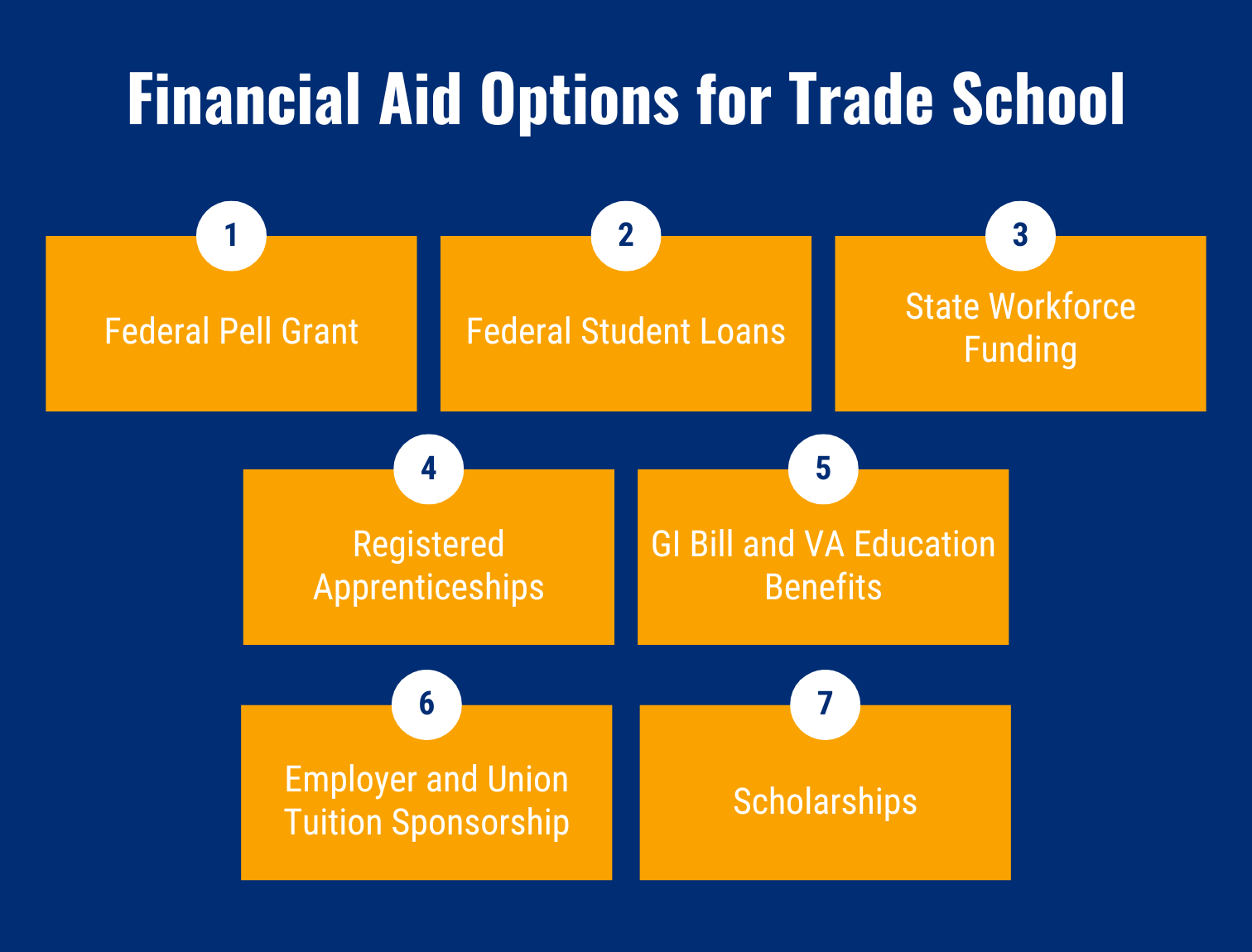
Beyond the FAFSA, trade school students typically draw on some combination of the following:
- Federal Pell Grant. The maximum award for the 2025-26 and 2026-27 award years is $7,395, with a minimum of $740. Pell Grants don’t need to be repaid, and can be used at any eligible community college, career school, trade school, or four-year college. Award amounts change most years, so it’s worth confirming the current figure directly.
- Federal student loans. Standard federal loans are available at any eligible trade school, on the same terms as at a community college or university.
- State workforce funding. State and local workforce boards fund training for eligible adults, including dislocated workers and those under certain income levels, through a federal program called WIOA. Voucher amounts vary by state; Indiana, for example, caps its vouchers at $8,500.
- Registered Apprenticeships. These combine paid, on-the-job training with related classroom instruction, often at no cost to the apprentice. The U.S. Department of Labor reports more than 800,000 active apprentices nationally, an average starting salary after completion of $86,000, and a 93% employment retention rate.
- GI Bill and VA education benefits. These cover vocational and non-degree programs, licensing and certification tests, and apprenticeships, including monthly living-expense payments under the Post-9/11 GI Bill. The VA specifically names plumbing and electrical work among eligible trades. Veteran’s education benefits covers this in more detail.
- Employer and union tuition sponsorship. Many employers and trade unions cover training costs directly. Reported reimbursement amounts commonly run $5,000-$10,000 a year, and union apprenticeships in fields like electrical work often fold tuition into paid training instead of billing it separately.
- Scholarships. Industry sponsors, including some large employers in the trades, sometimes fund trade-specific scholarships. Reported programs typically offer anywhere from a few dozen to a few hundred awards a year per sponsor.
No single federal source tracks a typical trade school financial aid package the way NCES does for four-year students, so this picture draws on three separate sources: the Department of Education, the Department of Labor, and the VA.
Is Trade School Worth the Cost?
The most detailed return-on-investment research on career and technical programs comes from Georgetown University’s Center on Education and the Workforce. Its 2025 rankings of more than 4,600 colleges found that top-performing trade certificate programs deliver a 10-year return of $448,000 to $607,000, in many cases outperforming bachelor’s degree programs over that same window. The main reason: certificate and associate-degree graduates usually start earning several years earlier than bachelor’s-degree graduates and carry much less debt, even though bachelor’s-degree holders tend to earn more cumulatively over a full career. The growth of artificial intelligence has increased demand for skilled trades, as the data centers powering AI require electricians, HVAC technicians, and other tradespeople to build and maintain them.
Median annual wages reported by the Bureau of Labor Statistics (May 2024) for common trade occupations:
- Entry-level Electricians: $62,350
- HVAC mechanics and installers: $59,810
- Diesel service technicians and mechanics: $60,640
- Plumbers, pipefitters, and steamfitters: $62,970
Payback period. Several financial calculators and industry sources, not government data, estimate that trade school graduates recoup their program cost within roughly one to two years of full-time work. The same sources estimate a breakeven point against a four-year degree, accounting for the four-year student’s lost earning years and loan payments, of roughly 8 to 12 years after high school graduation, depending on the field. These figures come from third-party financial analysis, not the Bureau of Labor Statistics or the Department of Education, and should be treated as estimates rather than verified statistics.
Frequently Asked Questions
Is trade school cheaper than a four-year degree?
Yes, in almost every case. Trade programs run for months rather than years, so total cost is usually a small fraction of a four-year degree.
Do all trade schools accept federal financial aid?
No. Only schools that are accredited or state-approved for federal aid can offer it, so confirming a school’s status is worth doing before applying.
Are payment plans available for trade school?
Yes. Many schools offer in-house payment plans to help cover costs financial aid doesn’t fully pay for.
Are scholarships available specifically for trade school students?
Yes. Some industry sponsors and large employers fund scholarships aimed at students entering the trades, though award amounts vary by sponsor.
Does the GI Bill cover trade school?
Yes, at approved schools. It can also help cover some licensing and certification exam costs, not just tuition.
Is a deposit or registration fee required before classes start?
Some schools charge a registration or enrollment fee to hold a seat in an upcoming class. This is separate from full tuition and is usually much smaller.
Is trade school cost the same at every school?
No. Cost depends heavily on the school and program; public schools generally cost less per year than private ones.
Does trade school tuition include job placement help after graduation?
Often, yes. Many schools include job placement assistance as part of the program at no extra charge.
Talk to a Financial Aid Advisor
Every school’s aid package looks different once accreditation, program length, and individual eligibility are factored in. New Castle School of Trades’ financial aid office can walk through FAFSA, Pell Grants, veteran’s benefits, and payment plan options for programs at its New Castle, PA and East Liverpool, OH campuses.