
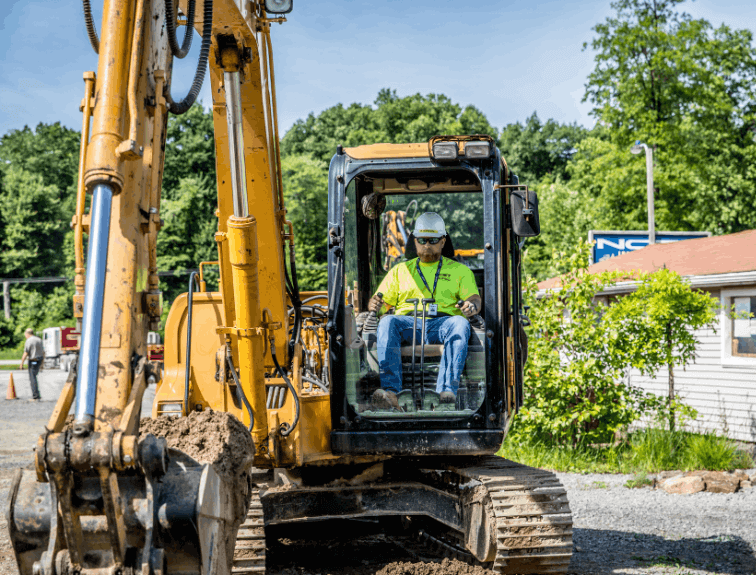
The construction industry is short of qualified heavy equipment operators. For people evaluating career options in the trades, skilled operators are in demand, employers are competing to hire them, and training takes less than a year through a trade school program.
What is a Heavy Equipment Operator?
Heavy equipment operators control large machines used in construction, mining, utilities, and agriculture. They move earth, lift materials, grade land, and prepare job sites for building. Precision matters because these machines can weigh tens of thousands of pounds and operate near other workers.
Types of Equipment
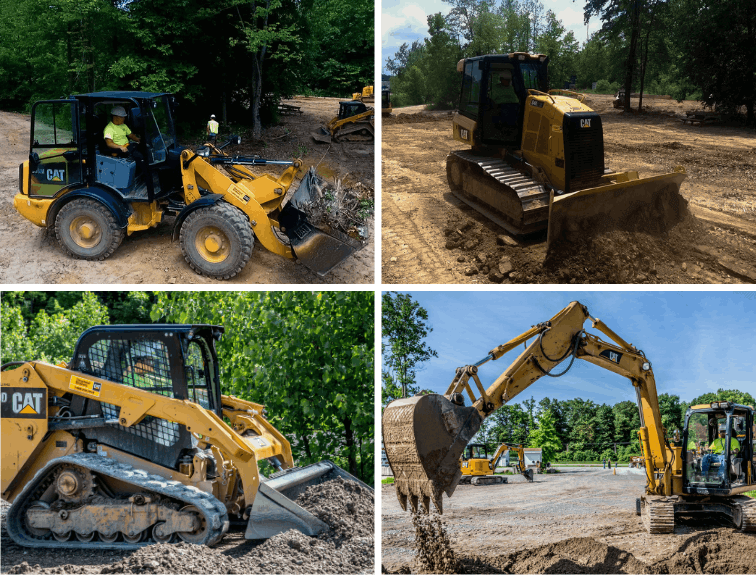
- Excavators: dig trenches, foundations, and drainage channels
- Bulldozers: clear and push large volumes of earth
- Backhoes: versatile machines that dig and load in a single pass
- Cranes: lift and position steel beams, concrete panels, and heavy loads
- Motor graders: create smooth, level surfaces for roads and pads
- Loaders: move materials across a job site
Daily Responsibilities and Work Conditions
Operators begin each shift with a safety inspection covering hydraulics, fuel, and mechanical systems. Before the machine moves, they review a site plan (a scaled drawing showing layout, dimensions, and elevation targets), so they understand grading specifications (the required slope or elevation of the finished ground surface) and project goals.
During the workday, they manage multiple controls at once while tracking workers, obstacles, and ground conditions. Basic maintenance is also part of the job:
- Greasing joints
- Checking fluids
- Reporting issues
Work is performed outdoors year-round. Shifts commonly run eight to twelve hours, overtime is frequent during active construction seasons, and colder climates like western Pennsylvania and eastern Ohio see seasonal slowdowns over winter.
Skills Required
- Hand-eye coordination — essential for precise control of hydraulic systems and machine movements
- Spatial reasoning — helps judge distances, angles, and clearances in tight or congested work areas
- Physical stamina — shifts run eight to twelve hours in variable weather; lifting 50 or more pounds is routine
- Mechanical aptitude — ability to detect unusual sounds or performance issues and communicate them clearly to maintenance teams
- Safety awareness — must guide every decision on a job site, from pre-shift inspection through shutdown
Certifications and Licensing
Credentials demonstrate that an operator understands safety protocols and can handle equipment responsibly. The table below summarizes the most common certifications and who needs them.
| Certification | What It Covers | Who Needs It |
| OSHA 10-Hour | Hazard recognition, site safety, worker rights | All operators |
| OSHA 30-Hour | Expanded safety for lead and supervisory roles | Lead operators, foremen |
| NCCER credentials | Craft-specific skills, portable across employers | Students in affiliated programs |
| NCCCO | Crane-specific operation and safety | Crane operators only |
Certifications have expiration dates and require periodic renewal. State licensing rules vary, so check state requirements before enrolling in training.
Class A CDL: Why Equipment Operators Get One
You aren’t required to hold a CDL to operate heavy equipment on a job site. Federal regulations do not classify an excavator, bulldozer, backhoe, or motor grader working within a private construction site as a commercial motor vehicle. OSHA safety training and employer certifications govern on-site operation.
However, when equipment must be transported between job sites on public roads, a Class A CDL is required. Since most heavy equipment cannot travel on public highways under its own power, it is usually loaded onto a tractor-trailer for transport. That tractor-trailer combination requires a Class A CDL.
Heavy equipment operators who can both operate machines on site and drive the transport truck between jobs are significantly more valuable to employers. That dual capability may be the deciding factor in hiring decisions.
Some programs integrate Class A CDL preparation into the heavy equipment curriculum, so students can earn both credentials in a single enrollment period.
Getting a CDL in Pennsylvania
The steps below reflect Pennsylvania’s CDL process. Ohio applicants should confirm requirements with the Ohio Bureau of Motor Vehicles. Applicants must hold a valid non-commercial driver’s license and be at least 18 for intrastate driving or 21 for interstate driving.
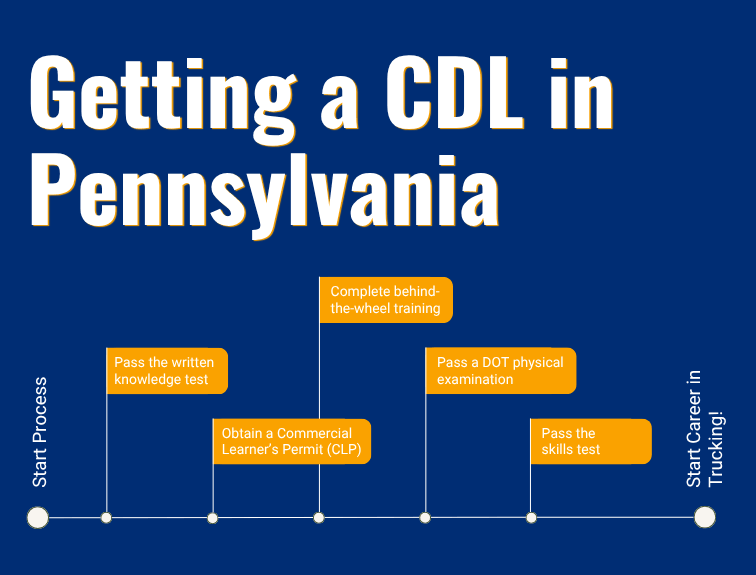
- Pass the written knowledge test. The Class A test covers general knowledge, air brakes, and combination vehicles. Applicants study from the PennDOT CDL manual and test at a Driver License Center.
- Obtain a Commercial Learner’s Permit (CLP). PennDOT issues a CLP valid for 180 days, allowing behind-the-wheel practice with a certified instructor.
- Complete behind-the-wheel training. Training must come from a program approved by PennDOT and listed on the FMCSA Training Provider Registry.
- Pass a DOT physical examination. A certified medical examiner must confirm the applicant is physically qualified to operate a commercial vehicle. The Medical Examiner’s Certificate is valid for up to 24 months and must be kept current.
- Pass the skills test. The road test covers a pre-trip inspection, off-road maneuvers, and a parking exercise.
Steps to Become a Heavy Equipment Operator
No prior machine experience is required. Programs are designed for beginners and can typically be completed in six to eighteen months, depending on the path chosen.
1. Enroll in a training program
Look for programs that combine classroom instruction with significant hands-on machine time, cover multiple equipment types, and include safety certification preparation. Trade school diploma programs typically run 30 weeks to one year.
2. Gain seat time
Seat time, the hours spent operating equipment, separates trained operators from untrained ones. Quality programs provide supervised time on excavators, bulldozers, backhoes, and loaders, and teach students to read site plans and grading specifications.
3. Earn certifications and consider adding a Class A CDL
OSHA 10-Hour certification is required on virtually every commercial job site and should be a priority. Operators who also hold a Class A CDL can drive the transport truck that hauls equipment between job sites, a skill many employers consider a significant advantage, and programs that include CDL preparation allow students to earn both credentials without extending their training.
4. Understanding trade school vs. apprenticeship
Trade school is a realistic starting point for most beginners. Union apprenticeships through the International Union of Operating Engineers (IUOE) take three to four years, combine paid on-the-job training with classroom instruction, and lead to union membership with higher pay floors and better benefits, but typically require prior construction experience, a high school diploma or GED, and a basic aptitude test.
For most people entering the industry with no background, trade school is the first step. The experience is often what makes an applicant eligible for an apprenticeship later.
5. Apply for entry-level positions
Entry-level operators typically start at construction companies, utility contractors, and mining operations. Most new hires begin on lower-complexity equipment under supervision before being assigned independent tasks, a ramp-up that is shorter for graduates who arrive with foundational skills already in place.
Career Path and Job Outlook
What Operators Earn
According to BLS May 2024 OEWS data, the median annual wage for construction equipment operators was $58,320. Wages in Pennsylvania and Ohio are consistent with national medians.
Job Outlook
BLS projects 4 percent employment growth for construction equipment operators from 2024 to 2034, with approximately 46,200 openings per year over the decade. Most openings are driven by retirements, since roughly 70 percent of current operators are 50 or older, and demand extends beyond construction into utilities, mining, and agriculture.
Advancement
Operators who master multiple machine types and maintain strong safety records earn access to more complex projects and higher-paying assignments. With experience, operators move into site supervision, equipment maintenance coordination, or training roles, and some establish independent contracting businesses.
Start Your Heavy Equipment Training at New Castle School of Trades
New Castle School of Trades offers a 30-week Heavy Equipment Operations program at its New Castle, PA campus. Students train on excavators, front loaders, backhoes, bulldozers, and dump trucks using both lever-style and joystick controls. The program includes Class A CDL exam preparation and the opportunity to earn NCCER credentials. Graduates qualify for entry-level positions as equipment operators, dump truck drivers, and grade helpers. Job placement assistance is included.
Learn more at about our Heavy Equipment Operations training program.
Conclusion
A career as a heavy equipment operator offers competitive wages, steady demand, and a clear path from training to employment. The median wage exceeds the national median for all occupations, and the job requires no four-year degree.
With roughly 70 percent of the current operator workforce aged 50 or older, qualified new operators are entering a job market that is actively looking for them.
Frequently Asked Questions
What certifications do I need to become a heavy equipment operator?
OSHA 10-Hour is standard across the industry. Programs affiliated with NCCER allow students to earn portable, industry-recognized credentials. New Castle School of Trades students are eligible to attempt NCCER certifications, and crane operators need separate NCCCO credentials regardless of where they trained.
What are entry-level jobs in heavy equipment operations?
Jobs include equipment operators, dump truck drivers, tractor-trailer drivers, grade helpers, and forklift operators. With a Class A CDL, the range expands further, and New Castle School of Trades graduates receive job placement assistance to connect with hiring employers in the region.
Do I need to pass a drug test to be a heavy equipment operator?
Most construction employers require a pre-employment drug test, and CDL holders are subject to ongoing federal testing requirements under FMCSA regulations throughout their careers. A positive result will typically disqualify a candidate from employment.