
Trade school gets you into a lab and out with a credential in under a year and a half. An apprenticeship pays you a wage from day one and takes two to five years to reach journeyworker status. Neither path requires a four-year degree, and in western Pennsylvania and eastern Ohio right now, a growing number of students are doing both: trade school first, then a registered apprenticeship for advanced standing and higher wages. Here is how the two paths compare and what the latest Pennsylvania apprenticeship data says about the market.
Trade School and Apprenticeship, Defined
A trade school (also called a vocational or technical school) is a school-based program where students train full time in labs and classrooms, typically for a fixed number of weeks. Programs end in a diploma or an Associate in Specialized Technology Degree. This credential signals to an employer that a graduate already knows how to run the equipment and follow the safety procedures of a trade before their first shift.
A registered apprenticeship is a structured, employer-sponsored training model registered with a state or federal apprenticeship office (in Pennsylvania, the Department of Labor & Industry’s Apprenticeship and Training Office). Apprentices work and earn wages from day one, while completing required instruction, called related technical instruction and on-the-job hours. Most registered apprenticeships in the trades run two to five years and end in a journeyworker credential, a nationally recognized certificate of completion.
Trade School vs. Apprenticeship at a Glance
| Trade School | Registered Apprenticeship | |
| Typical timeline | 6 weeks to about 60 weeks, depending on program | 2 to 5 years, depending on trade |
| Wages during training | None; students pay tuition | Pay varies |
| Who funds it | Student, Financial aid, and Scholarships | Employer or union sponsor funds |
| Entry requirements | High school diploma or equivalent; enrollment through the school | Sponsor selection, often through an application, interview, or aptitude test; may require a diploma, certification, or trade school credit |
| Credential earned | Diploma or Associate in Specialized Technology Degree | Journeyworker certificate, nationally recognized through the U.S. Department of Labor |
| How fast you’re job-ready | Entry-level skills and shop familiarity in months | Full occupational competency after years of supervised and paid work |
| Best fit | Students who want structured, full-time training and a credential before entering the workforce | Students who want to earn while they learn and already have or know a sponsor |
The Trade School Path
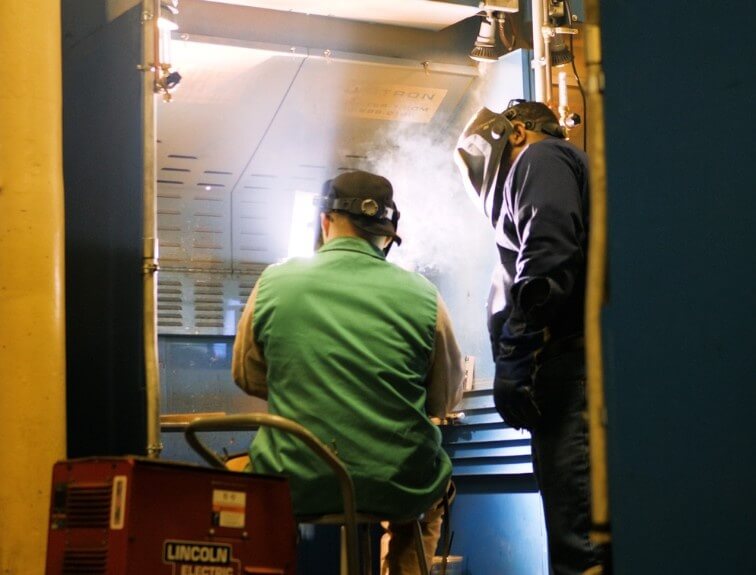
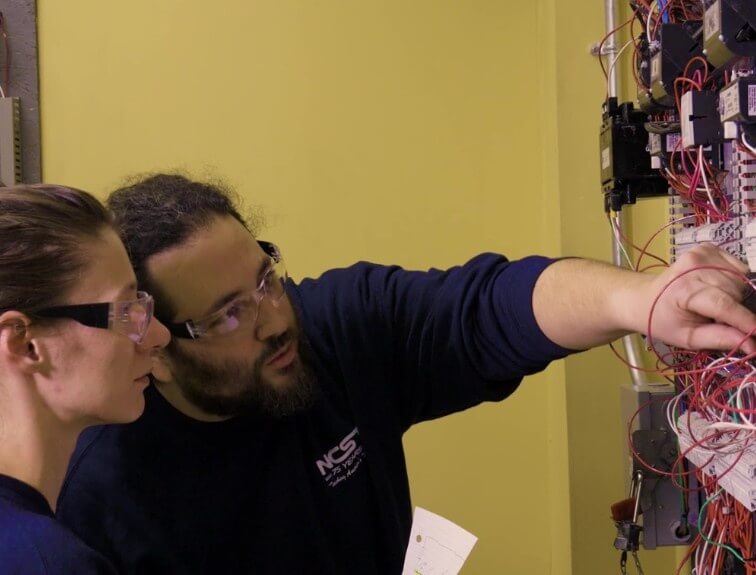
Trade school programs at New Castle School of Trades run 30 to 60 weeks for most diploma and degree tracks, with shorter certificate courses (Class B CDL, state inspection classes) running just a few weeks. Students train on industry-standard equipment: oscilloscopes and motor control panels in Electrical Technology, diagnostic scanners and fuel injection test stands in Diesel & Heavy Equipment Repair Technology, framing and masonry stations in Building Technology.
What Trade School Does Well
- Gets a student into hands-on lab work immediately, rather than waiting for a sponsor to accept them
- For a recent high school graduate, trade school is a lot more accessible than an apprenticeship
- Delivers a credential (diploma or degree) that an employer can verify
- Compresses training into months, not years, so students reach entry-level employment faster
- Builds classroom fundamentals (code, safety, theory) before a student is expected to perform under supervision on a jobsite
- Connects you with employers and help you get a job in your field
The Apprenticeship Path
Registered apprenticeships flip the order: a sponsor (an employer, a union, or a joint labor-management program) hires an apprentice, pays a wage, and provides structured on-the-job training alongside required classroom hours.
What Apprenticeship Does Well
- Pays a wage from the first day of training, so there are no tuition bill and no unpaid training period
- Builds years of hands-on, supervised experience directly in the trade and the employer an apprentice may end up working for long-term
- Ends in journeyworker status, the highest non-management credential in many union and open-shop trades
Getting an apprenticeship with no experience is difficult. Sponsors are selective and popular programs (electrical, especially) can have waitlists or competitive entry requirements. Going to trade school strengthens your resume, expands your network to find opportunities and speeds up the apprenticeship process.
Many Students Do Both: Trade School First, Then Apprenticeship
The choice between trade school and apprenticeship is not either-or. A common sequence is to complete a trade school program first, then enter a registered apprenticeship. Some trade school hours count toward the apprenticeship’s required on-the-job or classroom hours, shortening the time it takes to reach journeyworker status.
Instructors across New Castle School of Trades program instructors teach to industry-recognized standards. Like the ASME and AWS specifications in Combination, which is part of why graduates can move into apprenticeship-track roles instead of starting from zero.
NCST has spent over 80 years of operating in New Castle and building relationships with employers. Companies return year after year to the school’s career fairs looking for graduates ready for apprenticeship-track or direct-hire positions.
Apprenticeships in Pennsylvania Are Growing
Pennsylvania’s registered apprenticeship system has grown fast. New apprentices rose from 4,693 in 2022 to 6,021 in 2024, a 28.3% increase, and the state ranked 3rd nationally for completions in federal fiscal year 2024, according to Northwest PA Job Connect’s March 2025 board staff report.
Why It Matters
Pennsylvania leads its five-state federal region (Delaware, Maryland, Pennsylvania, Virginia, and West Virginia) in active apprentices, new apprentices, and completions. For students near Pittsburgh, New Castle, and Youngstown, that means a growing pipeline right next door.
It matches what NCST sees locally. Demand for Electrical Technology and Diesel & Heavy Equipment Repair Technology graduates keeps rising as data center and energy investment moves into western Pennsylvania, the same corridor feeding this pipeline.
The Takeaway
None of this replaces trade school. It confirms the regional apprenticeship pipeline, whether in union halls, manufacturers, or contractors, is expanding, not shrinking. Kenny Alli, an NCST Electrical Technology grad from Youngstown, was hired onto a job site before he finished his third quarter.