
Trade school leads to so many stable, licensable careers: electrician, HVAC technician, plumber, welder, automotive technician, carpenter, and diesel or heavy equipment technician. Over time, many move into supervisor, business owner, or inspector roles. Most of these jobs pay above the median wage for all U.S. jobs. Several are also growing faster than the national average.
Key Takeaways
- Seven core trades cover most trade school graduates: electrical, HVAC/refrigeration, plumbing, welding, automotive technology, carpentry/construction, and diesel/heavy equipment technology. Each has its own entry-level jobs, licensing rules, and pay range.
- Pay generally beats the national median. The median wage across all U.S. jobs was $49,500 in May 2024. Electricians ($62,350), plumbers ($62,970), heavy equipment technicians ($62,740), and carpenters ($59,310) all pay more than that, according to the Bureau of Labor Statistics (BLS).
- Job growth varies a lot by trade. Electricians and HVAC technicians are projected to grow 9% and 8% through 2034. That’s well above the national average for all jobs. Welding is projected to grow just 2% over the same period, according to BLS 2024-34 projections.
- Careers follow a common ladder. Workers start as apprentices, then move up to journey-level. In some trades, they can reach master-level next. After that comes supervisor or foreman, and for many, business owner. BLS lists business ownership as a common path for electricians, plumbers, carpenters, and HVAC technicians.
- Trade experience opens doors beyond the tools. Construction and building inspectors, cost estimators, and construction managers all hire many workers who started in a trade.
Jobs by Trade
Electrical
Electricians install, maintain, and repair the wiring, lighting, and control systems that run homes, businesses, and factories. Most start with a high school diploma and no prior electrical experience. They then learn the trade through a paid apprenticeship. The Occupational Information Network (O*NET) calls this a “Job Zone Three” job. That means it usually needs some vocational training or an associate’s degree, not a four-year degree.
Entry-level titles include Maintenance Electrician, Wireman, and Housing Maintenance Electrician. As electricians gain hours and pass licensing exams, they move into more advanced titles:
- Industrial Electrician
- Control Electrician
- Inside Wireman
- Electrical Troubleshooter
After meeting state requirements and working at journey level, electricians can move up to master electrician, supervisor, or project management roles, according to BLS.
Pay varies by employer. Government electricians earned a median of $77,080 in May 2024. This does not count electricians working in state and local education or hospitals. Manufacturing electricians earned $71,820. Electricians working for electrical contractors earned $61,290. Overall median pay for the job was $62,350 a year, or $29.98 an hour.
The BLS projects electrician jobs to grow 9% from 2024 to 2034. That’s much faster than the average for all jobs. They also expect about 81,000 job openings a year, most from workers retiring or changing fields. Electricians can also add certifications in solar power systems, electrical generation, or lighting systems.
HVAC and Refrigeration
Heating, air conditioning, and refrigeration technicians install and repair the systems that heat and cool buildings. The typical entry credential is a postsecondary nondegree award. This is what most trade school certificate programs provide. Long-term on-the-job training follows. Pay starts lower for apprentices and rises as skills grow, according to the BLS.
Seventy percent of HVAC technicians work for plumbing, heating, and air-conditioning contractors. The rest are split among self-employed workers (5%), wholesale trade, educational services, and retail trade (3% each). Median pay for the job was $59,810 a year ($28.75 an hour) in May 2024. The BLS projects 8% job growth from 2024 to 2034, much faster than average, with about 40,100 job openings a year.
On large commercial jobs, the work often splits by specialty. Sheet metal workers handle ductwork. Electricians handle wiring. Plumbers or pipefitters handle the pipework. That overlap is one reason HVAC technicians often end up working alongside, or moving toward, other trades.
Plumbing
Plumbers, pipefitters, and steamfitters install and repair the pipes that carry water, steam, gas, and waste. The three job titles cover related but different work. Plumbers typically handle home and business water, drainage, and waste systems. Pipefitters often work on high-pressure industrial piping in factories, power plants, and chemical plants. Steamfitters focus on high-pressure steam systems.
Entry into the trade starts with a high school diploma and an apprenticeship. It usually runs four to five years and combines about 2,000 paid on-the-job hours a year with classroom instruction. Most states require a license to work on your own. O*NET’s sample job titles span entry to advanced work: Drain Technician and Plumbing Installer at the entry end, Pipe Welder and Sprinkler Fitter as specialties, and Service Plumber or Fire Sprinkler Service Technician as established, licensed roles.
After finishing an apprenticeship and earning a journey-level license, plumbers can move up to master plumber, supervisor, or project manager. Many eventually start their own contracting business. That may require an added contractor’s license, according to BLS. Median pay for the job was $62,970 a year ($30.27 an hour) in May 2024. The BLS projects 4% job growth from 2024 to 2034, on pace with the average for all jobs, with about 44,000 openings a year.
Welding and Metal Fabrication
Welders, cutters, solderers, and brazers join and cut metal using hand-held or remote-controlled equipment. This work shows up in construction, manufacturing, shipbuilding, and repair shops alike. Entry typically requires a high school diploma plus technical training and a moderate stretch of on-the-job instruction. There’s a wide range of welding careers to consider, from structural welding to pipefitting and inspection.
Median pay was $51,000 a year ($24.52 an hour) in May 2024. This trade’s growth number needs a closer look. The BLS projects 2% job growth from 2024 to 2034. The BLS still expects about 45,600 job openings a year, mostly from workers retiring or moving into other roles. Welding stays a widely needed skill across industries, even if it isn’t the fastest-growing trade on this list.
Automotive Technology
Automotive service technicians and mechanics inspect, maintain, and repair cars and light trucks. Many enter with a postsecondary nondegree award from a technical program. Some enter with just a high school diploma and learn through on-the-job training instead. Employers often require Automotive Service Excellence (ASE) certification on top of school training.
Pay depends a lot on where a technician works. Those employed at car dealerships earned a median of $58,580 in May 2024. That’s well above technicians at general auto repair shops, who earned an average of $35,310. The job’s overall median was $49,670 a year ($23.88 an hour). Many shops pay technicians on a “flat rate” or commission basis tied to labor billed on each job, not a straight hourly wage. That means income can depend on how much work a technician finishes, not just hours clocked.
The BLS projects 4% job growth from 2024 to 2034, in line with the average for all jobs, with about 70,000 openings a year. A closely related field, automotive body and glass repair, is a common next step for some auto-trained graduates who focus on collision work instead of mechanical repair. BLS tracks it as its own separate job.
Carpentry and Construction
Carpenters build, repair, and install the wood-framed structures behind most homes and commercial buildings. Entry usually starts with a high school diploma, followed by on-the-job learning or a formal apprenticeship. Some carpenters begin as construction laborers or helpers, a broader entry point into construction work, before they specialize in carpentry.
Median pay was $59,310 a year ($28.51 an hour) in May 2024. The BLS projects 4% job growth from 2024 to 2034, on pace with the average for all jobs, with about 74,100 new positions a year. Experienced carpenters can move into first-line supervisor roles, become lead carpenters on a crew, run their own contracting business, or take on general construction supervisor duties, according to the BLS.
Carpentry also feeds two well-paying advanced paths covered in more detail below: construction and building inspection, and construction management. Both fields often hire workers with a trade background instead of a construction degree.
Diesel and Heavy Equipment Technology
Heavy vehicle and mobile equipment service technicians inspect, maintain, and repair the trucks, tractors, and machines used in construction, farming, and other industries. The BLS groups three closely related jobs under this umbrella: farm equipment mechanics, mobile heavy equipment mechanics (except engines), and rail car repairers, who service locomotives, subway cars, and other rail equipment for railroads and transit systems.
Entry typically requires a high school diploma, followed by long-term on-the-job training. Median pay across the group was $62,740 a year ($30.16 an hour) in May 2024. The BLS projects 6% job growth from 2024 to 2034, faster than the average for all jobs, adding about 15,700 net new jobs.
Diesel technicians who focus on buses and trucks are tracked by the BLS as a separate, closely related job. Pay and demand for that specialty follow patterns like the broader heavy equipment field described above.
Who Hires Trade School Graduates
Trade school graduates work across a narrower set of employer types than the job titles might suggest. The mix shifts by trade:
- Electricians mostly work for electrical contractors and wiring installation firms. Many others work in manufacturing plants, government agencies (outside education and hospitals), and staffing agencies that place workers on contract.
- HVAC technicians mostly work for plumbing, heating, and air-conditioning contractors (70% of the job). Smaller shares are self-employed or work in wholesale trade, education, and retail.
- Plumbers, pipefitters, and steamfitters split between contracting firms, self-employment, government, heavy and civil engineering construction, and manufacturing plants that need industrial piping maintained.
- Automotive technicians work at car dealerships, independent repair shops, and parts and tire retailers. Dealership jobs generally pay the highest median wage of the three.
- Carpenters mostly work for home and commercial building contractors and specialty trade contractors. A large share eventually become independent contractors.
- Heavy equipment and diesel technicians work for construction contractors, farm and garden equipment dealers, railroads and transit agencies, and government fleets.
Across nearly every trade, self-employment and small-business contracting make up a real, sizable slice of the workforce, not a rare exception. That pattern carries through to the advancement paths described next.
How Trade Careers Advance: From Apprentice to Business Owner
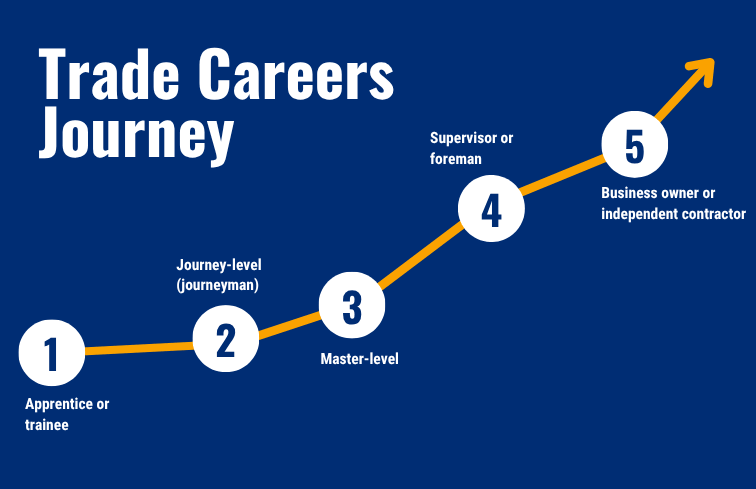
Most licensed trades follow a similar ladder. The BLS documents this directly on its occupation pages for electricians, plumbers, and carpenters:
- Apprentice or trainee. Paid, structured on-the-job training combined with classroom instruction, typically three to five years depending on the trade. Pay rises as skills and hours add up.
- Journey-level (journeyman). The apprenticeship is done, and where required, the worker holds a state license. Journey-level workers can operate on their own on a job site.
- Master-level. Electricians and plumbers can pursue an added license. It usually requires more years of experience plus a separate exam. Several states require master-level licensing before a worker can hold a contractor’s license.
- Supervisor or foreman. O*NET tracks this step as its own job, First-Line Supervisors of Construction Trades and Extraction Workers. Sample titles include Construction Foreman, Site Superintendent, and Electrical Supervisor. This role sits above journey-level work and usually means overseeing a crew instead of doing every task by hand.
- Business owner or independent contractor. The BLS names this directly as a common path for electricians, plumbers, carpenters, and HVAC technicians. It usually requires an added contractor’s license on top of a trade license.
Union apprenticeship programs run alongside this ladder in several trades. The BLS’s own HVAC job page, for example, points to the United Association of Plumbers, Fitters, Welders and Service Techs as a resource for apprenticeship information. That confirms union training as a recognized entry route, not just an alternative to it.
Frequently Asked Questions
What is the highest-paying job after trade school?
Among the jobs covered here, construction managers had the highest median pay, at $106,980 a year in May 2024. That role typically needs a bachelor’s degree, though experienced tradespeople sometimes become self-employed general contractors instead. Among trades that don’t require a four-year degree, plumbers and electricians led, both above $62,000 median.
Which trade has the best job outlook?
Electricians, projected to grow 9% from 2024 to 2034, followed closely by HVAC technicians at 8% and heavy vehicle and mobileequipment technicians at 6%. Both figures are well above the national average for all jobs.
Can trade school graduates start their own business?
Yes. The BLS names business ownership as a direct path for electricians, plumbers, carpenters, and HVAC technicians. This usually happens after reaching journey or master level and getting a contractor’s license.
Do construction inspectors and cost estimators need a college degree?
Not always. Construction and building inspectors typically need a high school diploma plus five or more years of trade experience, according to the BLS. Cost estimators typically need a bachelor’s degree, but workers with a lot of construction experience sometimes qualify without one.
What’s the difference between an apprentice, a journeyman, and a master?
An apprentice is in paid, structured training and hasn’t yet finished the required hours or coursework. A journeyman (journey-level worker) has finished an apprenticeship and, where required, holds a license to work on their own. A master, a title used mainly for electricians and plumbers, has logged extra years of experience and passed a further license exam. This is often a requirement for holding a contractor’s license.