
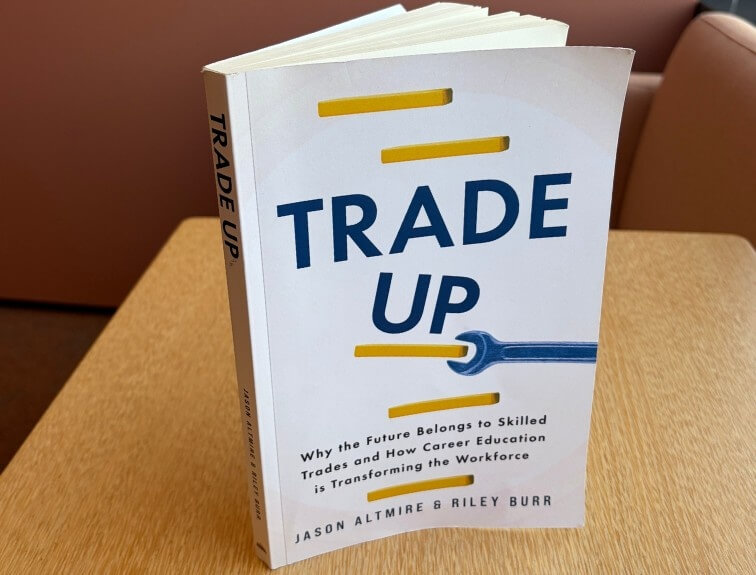
Last month, Dr. Jason Altmire stopped by the New Castle School of Trades campus. Altmire spent three terms in the U.S. House of Representatives before moving into a career focused on workforce education. He now leads Career Education Colleges and Universities, the national association that represents private trade schools and career colleges across the country.
Earlier this year, Altmire and co-author Riley Burr released a book called Trade Up: Why the Future Belongs to Skilled Trades and How Career Education Is Transforming the Workforce. Burr, the book’s co-author, serves as Vice President of Policy and Research at CECU. Together, the two spend 168 pages making a direct argument: America does not have a jobs problem. It has a trained-workers problem.
That argument is worth a closer look for both people working in the trades and for anyone weighing a trade school education against a traditional four-year path.
The Problem the Book Opens With
Altmire and Burr focus on a paradox. Record numbers of college graduates cannot find jobs in their field. At the same time, employers in fields like construction, manufacturing, and transportation cannot find enough qualified workers to fill open positions. The book argues that this gap did not happen by accident. It happened because American culture spent decades pushing one path (a four-year degree) while treating skilled trade work as a backup plan and not worthy of young people’s attention.
The authors put it plainly on page 45, writing that the country needs to examine “the primary driver behind the millions of unfilled job openings in essential blue-collar fields: the negative social and cultural perceptions around the jobs that so desperately need workers.”
That is the core of the book. Not a lack of jobs, a lack of respect and training for the jobs that already exist.
Employers Share the Responsibility
Trade Up does not let employers off the hook either. A good portion of the book looks at how companies plan (or fail to plan) for the workers they will need down the road. On page 154, the authors compare a poorly prepared workforce to a boat that goes over Niagara Falls. By the time anyone notices the wreckage, they write, “the damage has already been done but could have been prevented with better foresight and preparation.”
For a program like Commercial Truck Driving, that point can be a powerful lesson. Trucking companies across the country have talked about driver shortages for years, the book’s argument suggests the fix starts long before a shortage becomes a crisis. It starts with employers, schools, and students working together earlier, not scrambling for workers after the gap has already opened.
Making sure that young people know that there are trades careers out there for them to step into will tell them exactly what they need to hear, that not going to a four-year school is an option. It’s up to trades schools and trades employers alike to reach out to their local youth more than they already do, how can they know there’s opportunity waiting for them if they’re not told about it?
A Generation Ready to Build Something
One of the most hopeful threads in the book covers what Altmire and Burr call the “Toolbelt Generation.” Surveys cited around the book’s release show a real shift in how younger workers see trade careers. A large share of Gen Z respondents say they are open to a career in the skilled trades, and enrollment in vocational-focused programs has climbed for several years running. The authors treat this as a genuine turning point, not just a talking point. Recent coverage of the trades industry in western Pennsylvania and eastern Ohio backs that up. Interest in fields like welding, electrical work, and diesel repair has been climbing locally too, a trend NCST covered in a recent blog post on the trades boom in the region.

The Book’s Closing Argument
Trade Up does not end on a soft note. The final line of the book, on page 168, is short and direct: “There is simply no time to wait.”
That sentence sums up the whole book. Altmire and Burr are not asking readers to someday rethink how America trains its workforce. They are asking for action now, while the worker shortage in the trades keeps growing and while a new generation is already showing interest in filling it. There’s an old saying, “the best time to plant a tree is yesterday. The second-best time is today.” We should have started working to fill this gap in the job market years ago, but right now what we can do is keep working to fill the gap for the future by reminding everyone that working in trades is extremely dignified and is a path to a successful life.
Our Visit With Altmire
A visit from someone like Dr. Jason Altmire is not just a photo opportunity for us. He runs the organization that represents career colleges nationwide, and his work on making the case that trade schools are part of the solution to a real economic problem has had a huge impact on schools like us. Meeting with him in person at our trade school gives it weight that a policy paper cannot. Meeting with him reminds us that we have strong allies in the fight to prove that trade schools like NCST are helping our workforce in a big way.
Trade Up is available now through Sunbury Press and major booksellers.